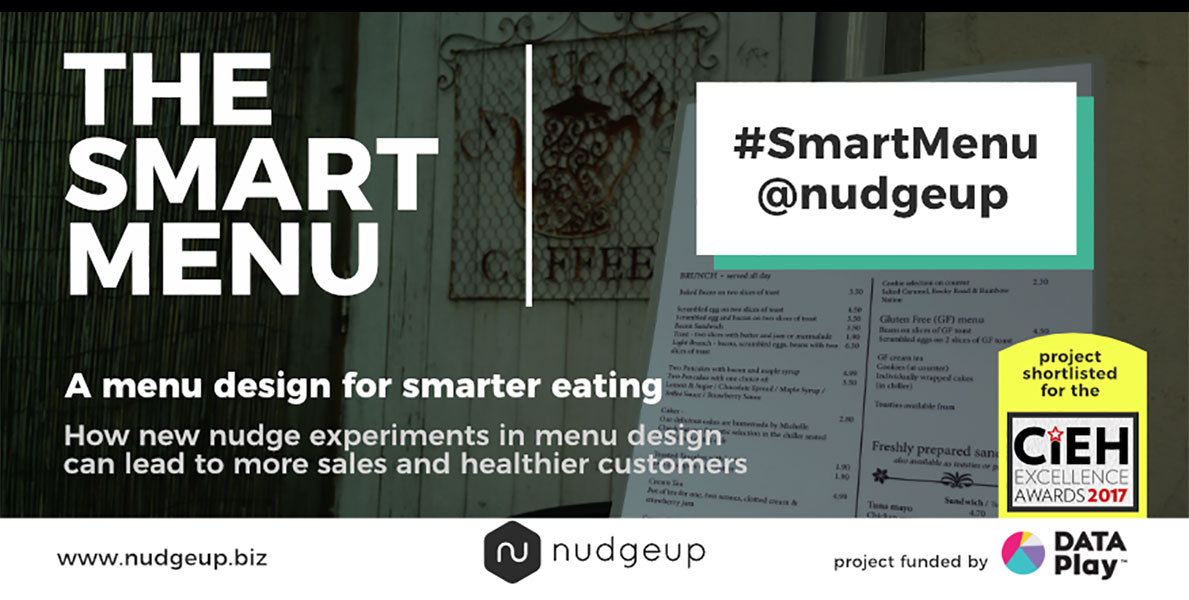
Restaurant menu nudge

DATA Play 5

NudgeUp

Investigate how menu design can impact people’s choices.

The restaurant menu nudge was a project that came out of DATA Play 5 by NudgeUp that proposed an idea to look at menu design and how it impacts on peoples choices. The menu could be used by any restaurant/cafe in Plymouth to boost sales of healthy foods, making them more accessible, appealing and appetising.

The inspiration

The overeating world

“What should I get to eat?” is one of the most perplexing and frustrating questions we find ourselves asking countless times each day. In fact, we’ve invented new words (hangry – bad-tempered or irritable as a result of hunger) just so we can describe our frustrations when trying to answer it. This question becomes particularly difficult when we start to look at the environments in which we must make our food decisions – cafes and restaurants. In these environments, the menus primarily include unhealthy foods containing high sugars, fats, and salts. Combine this offering with the fact that we are often tired, stressed, and hungry when ordering food, and you can see why we seek unhealthy food for its fast fixes. Unfortunately, this behavioural pattern impedes our desires and aspirations to lead a healthy lifestyle and eat a well-balanced diet.

The impact of the predicament outlined above, is clear if we look at some numbers; 63 per cent of adults, living in England are classed as overweight or obese. Over 1 in 3 children in the UK are also classed as overweight or obese. And by 2050 more than half of the UK population could be obese. These statistics are pretty staggering. Perhaps what is more interesting, is the idea that nationally we attempt to promote healthier lifestyles but have predominantly targeted the individual and their self-control (dieting and weight loss). Yet, the environments that we move in, continue to be tailored towards unhealthy eating.

A shift in perspective

The prevalence of unhealthy environments is easily explained. Food establishments stock unhealthy food because it sells more – that’s their incentive. But is environment as important as the individual in our quest to pursue healthier lifestyles? The answer is yes. If we turn our attention to the world of behavioural insights, specifically nudges, we find out that our food choices are mostly governed by the design of our environment itself.

A nudge is an innovative behavioural insight method that aims to alter an individual’s behaviour by changing the design and layout of the environment. For instance, by moving apples to eye-level, in a cafeteria, you can increase the likelihood of apples being purchased. Implementing nudges in this manner, can shape a person’s food choices to be healthier.

The project

Putting health back on the menu

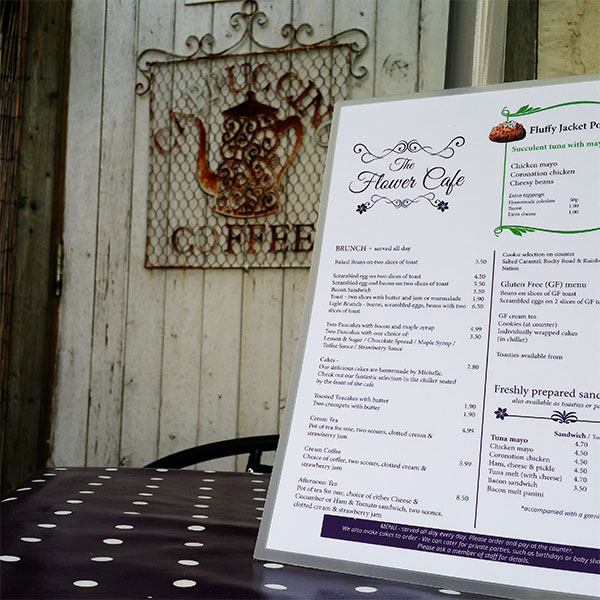
Recent nudge research has supported the idea that the way a cafe’s or restaurant’s menu is designed (colours, icons, words, fonts) can significantly influence how people order food, regardless of what they think they want or need to eat. All it takes is a number of design tweaks and an insight into the behavioural processes behind decision-making. This is where NudgeUp’s project idea was forged. They took these principles from nudge theory and previous research and applied them to a cafe menu in a real-life setting.

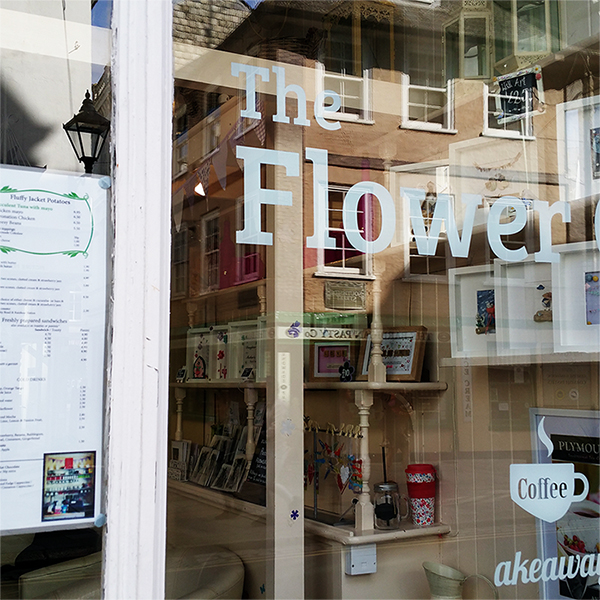
Fortunately, NudgeUp discovered a local cafe, in Plymouth (UK), and they were more than happy to collaborate on our nudge project. They had a traditional variety of foods on their original menu (ranging from pancakes to sandwiches) and 8 to 10 tables to seat around 30 customers.

After spending some time with the cafe owners and discussing their original menu, food items, and sales, NudgeUp decided to target their jacket potato sales with their nudge. They made this choice for a number of reasons. Firstly, jacket potatoes were deemed to be the healthiest selection on the menu. Secondly, the sales of jacket potatoes had been limited when compared to other food options. Finally and perhaps most importantly, jacket potatoes represented a food choice that if sold, could provide a high markup value for the cafe. To put this in context, initially, the cafe only sold a small amount of potatoes a week – if a ‘nudge-ified’ menu could increase the sales of jacket potatoes, then this would be a perfect incentive for other food establishments to think differently about healthy foods.

Our smart menu

NudgeUp focused on designing a new menu around three main behavioural principles:

  • Salience: Make the jacket potatoes eye-catching. Utilising colours, images, and the space of the menu to attract the customer’s attention.
  • Perceived quality: People are more likely to purchase something if they perceive it to have higher quality. Using previous research, we were able to change the way menu prices were represented, which in turn, influenced the perceived quality of the food.
  • Perceived taste: You are more likely to choose a food item if you know that it’s going to be tasty and enjoyable to eat. By utilising descriptive words such as ‘succulent’ and ‘fluffy’, you can enhance the perceived taste of the foods.

Once they had designed the smart menu, and consulted with the cafe about its design (they wanted to ensure that we maintained the branding of the cafe throughout the menu’s design), they planned out our experimental procedures.

Across a two-week period, they designed a study to test the effectiveness of our smart menus. During the first week of the study, they kept the cafe’s original menu in place and collected daily sales data through till receipts. During the second week, they removed all of the cafe’s original menus and replaced them with our smart menus – again collecting sales data through till sales (A-B style).

The outcomes

After analysing the sales data, NudgeUp discovered that when their smart menu was in the cafe, jacket potato sales were six times greater than the baseline sales.

In terms of percentages, that is an increase of over 500 per cent (533 per cent to be precise).

The insights

Let’s consider the spectrum of implications that have come out of this work. Firstly, in terms of health implications, NudgeUp have shown that through a simple change of menu design, you can radically affect a person’s food choice. Most importantly, you can generate healthier food choices. Crucially, this change is not motivated or fostered by an individual’s self-control or desire to be healthier but is instead, prompted by simple changes to an individual’s environment. Compare this with traditional interventions for health change that ask individuals to ‘watch what they eat’, calorie count, and restrain themselves. Here, the process is made simpler. The customer enters the cafe, sits down and looks at the menu. Due to the layout and design of the Smart Menu, the customer selects a jacket potato for lunch instead of an unhealthier alternative. Healthy eating becomes less effortful and more accessible than in traditional interventions.

Secondly, let’s consider the financial implications. With just a few changes to the architecture of the menu, the cafe gained a significant amount of extra turnover. The cost-effectiveness of these nudge interventions is hugely advantageous for all businesses (small, medium, and large); the difference between the project costs and revenue is remarkable, generating an impressive profit. By targeting healthy food items with high mark up, NudgeUp were able to promote healthier eating for customers while also generating a sizeable financial incentive for the business involved. Hopefully, this evidence can be utilised as a starting point to encourage food establishments to think differently about stocking healthy options.

More broadly, and beyond this project, it is important to note the scope of using nudge across various environments. The elegance of nudge allows application across multiple contexts. In terms of promoting health, consider the use of footprints on the floor to guide shoppers to healthier foods or even simply presenting fruit in smaller bite size chunks to encourage consumption; there are countless ways in which we can design ‘foodscapes’ to nudge people in the right direction. Going beyond healthy eating and the Smart Menu, the application of nudge for decreasing unhealthy habits (for example smoking), promoting prosocial decisions (for example recycling, using public bins), and encouraging future planning (for example financial saving, pension planning), makes it a practical, cost-effective, and sophisticated solution for the boundless list of 21st century problems.

In 2017, as part of the DATA Play nomination, the smart menu was shortlisted for a Chartered Institute of Environmental Health Excellence Award in the ‘Best Innovative Environmental Health Solution’ category and was featured in the Environment Health online magazine (February 2018)
Gallery

Content provided by Leigh Cooper, founder of NudgeUp – a team of researchers, psychologists and designers that all share the same vision – to create design that helps using a cutting-edge method, taken from the behavioural sciences, that can alter an individual’s choices by changing the design and layout of their environment.

News

DATA Play 11... tackling the climate emergency together

Published 6 September 2022
DATA Play 11 was a great success with discussions around the climate emergency and the environment.

Read more

Save a new date for DATA Play 11

Published 24 February 2022
We’ve rescheduled DATA Play 11 to 7 April 2022 due to the coronavirus situation and on advice from Public Health.

Read more

DATA Play 11: Climate emergency

Published 9 December 2021
Join us on 11 March 2022 for DATA Play 11 to look at how open data and technology can be used to help the climate emergency.

Read more

Save the date for DATA Play 11

Published 8 December 2021
Join us on 11 March 2022 for DATA Play 11 to explore how data and technology can help the city’s challenges around the climate emergency.

Read more

View the Plymouth Plan Annual Report

Published 23 July 2021
This annual report provides an overview of progress over the past year, for each of the different elements of the plan.

Read more

Tune in tomorrow for the Climate Challenge live final

Published 2 December 2020
The top three projects will now be taking part in the LIVE final taking place on Thursday 3 December at 7pm…

Read more

Join us for a Plymouth Climate Challenge live event

Published 26 September 2020
The top three supported projects will be awarded an additional £2,500 and be invited to the live event on Thursday 3 December…

Read more

Progress on the delivery of the Plymouth Plan

Published 23 November 2020
We’ve added a new Plymouth Plan section with infographics to show our progress on the Plymouth Plan primary indicators…

Read more

Competition time! Plymouth Climate Challenge LIVE

Published 24 September 2020
Plymouth City Council and Crowdfunder have teamed up to award £15,000 prize-funding to 10 climate emergency projects in the city…

Read more

DATA Play 10 is here... looking back and forward

Published 1 November 2019
DATA Play 10 kicked off to a great start with some really interesting discussions around past and future challenges…

Read more